
Key takeaways
- This is polarization through financing: not a shortage of capital, but a bifurcation.
- Each instrument, taken alone, follows its own risk logic. Taken together, they leave the asset that most needs a financing vehicle without a natural one.
- This is not a refusal. It is calibration.
3.3.1 — State-guaranteed loans (PGE) have largely been repaid: the sector has deleveraged, not recovered
We start with a correction. The diagnosis still circulating in the industry is no longer accurate. State-guaranteed loans (PGE) are no longer choking French hotels: they have largely been repaid. For micro, small, medium-sized and mid-cap companies (TPE, PME and ETI), across all sectors, 94% of the amounts granted had been repaid by the end of May 2026, and their outstanding balance now stands at just €8 billion.⁷⁹ According to estimates by the direction générale du Trésor (the French Treasury), the projected loss rate over the life of the scheme would be 5.9% for accommodation and food services, versus 9.5% for construction.⁸⁰ Altares (a business-information provider) makes the same observation: "the factors once singled out, such as PGE repayments or insolvency petitions by Urssaf (the social-security contribution collector), now play a much more limited role."⁸¹ This is, first, to the sector's credit: it repaid.
The balance sheet shows it. In accommodation alone (not accommodation and food services combined, where restaurants dominate), median financial debt to equity fell from 80.7% in 2023 to 66.6% in 2024. Net of cash, it fell from 12.5% to 8.5%.⁸² In a single fiscal year, the sector sharply reduced the burden it took on to get through the pandemic.
The second series gives the first its meaning. It moves the other way. Over the same period, from the same source and on the same perimeter, the share of income companies retain for self-financing fell from 25.3% to 21.8%. Operating investment as a share of value added fell from 9.0% to 8.3%. The profit share (gross operating surplus as a share of value added) also declined. The sector deleveraged, then, without any improvement in its capacity to generate internal funds: that capacity deteriorated. The two movements are simultaneous. We do not claim that one causes the other: we did not find any public statistic showing how much of the repayment came out of cash and how much came from deferred investment. They do, however, rule out the reassuring reading. A balance sheet that strengthens while self-financing falls does not describe a sector that is recovering. It describes a sector that has paid.
The financing question therefore shifts. It is no longer: can the independent core carry the crisis debt? It is: can it access the debt its modernization requires?
3.3.2 — The visible symptom: rising insolvencies; hotels less affected than restaurants, but seeing their own insolvencies rise again in 2026
One distinction matters here. Aggregated releases for the HCR sector (hotels, cafés, restaurants) often blur it, yet it is central: hotels do not behave like restaurants.
At the aggregate HCR level, the trend is steep. Business insolvencies, defined as the opening of collective proceedings (safeguard, receivership, liquidation) rather than mere payment delays, rose from 5,516 in 2022 to 8,714 in 2024.⁸³ The base year, 2022, was barely emerging from the pandemic. Restaurants account for most of them, and the pace there is not slowing.⁸⁴
Accommodation on its own, however, tells a different story. Volumes remain modest in absolute terms: 443 insolvencies in 2025, after 446 in 2024.⁸⁵ 2026 points to fragility in accommodation in the broad sense, driven by both hotels and short-term rentals — and shows it accelerating: 168 insolvencies in the first quarter (+27.3% year on year), then 133 in the second (+41.5%), including 91 hotels (+54%). On such small numbers (about sixty hotels a year earlier), these rates are volatile, and two quarters are not enough to establish a trend. Volumes remain on a different scale from restaurants (1,969 insolvencies in the second quarter); in growth-rate terms, on much smaller volumes, the pace is now faster in hotels.⁸⁶
The conclusion is therefore nuanced. On average, the sector has survived, and better than others: it repaid its crisis debt (3.3.1). But the 2026 acceleration is not a detail. It follows the decline in the sector's self-financing measured in 2024 (3.3.1). The most fragile remain exposed, and nothing suggests that the closures observed for more than a decade are stopping: according to the available counts, the stock is estimated to have lost between 1,100 and 1,430 hotels since 2019, mainly through non-replacement and closures at the lower end of the market, first in small towns and rural areas.⁸⁷,ᵈ Our hypothesis: many hoteliers do not file for insolvency; they defer renovation, which is less dramatic than a bankruptcy and more corrosive over the long term. We did not find any public statistic that measures the age of the stock or this renovation backlog.
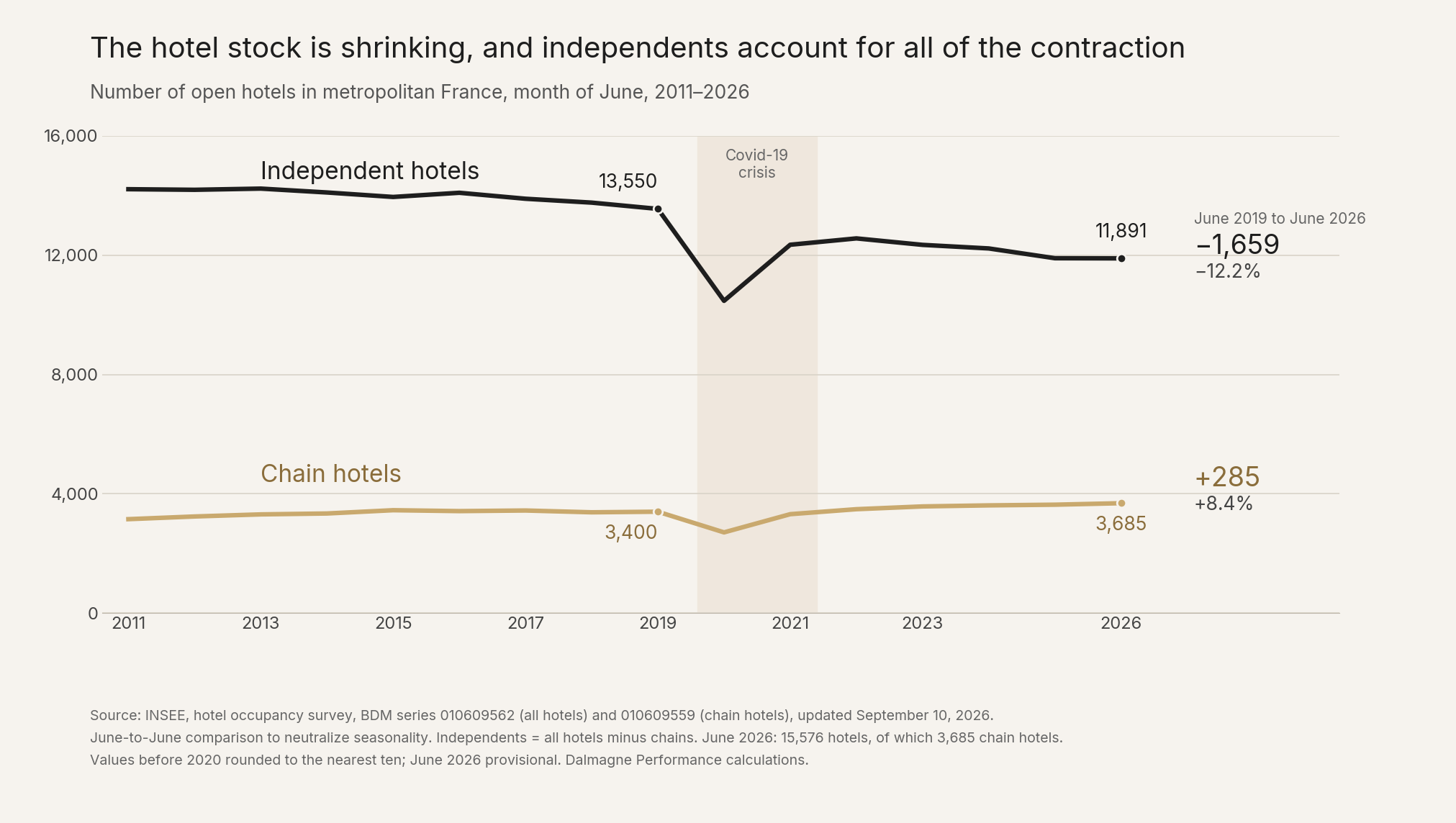
Two public series from INSEE (the national statistics office) take the analysis further and show who is disappearing. Between June 2019 and June 2026, the surveyed hotel stock lost 1,374 hotels. Chains gained 285. Independents lost 1,659 — 12.2% of their stock. Over fifteen years, the gap is wider still: −2,319 independents and +535 chain hotels between June 2011 and June 2026. The contraction of the stock is not a general phenomenon: the net change is negative for independents and positive for chains. This net figure combines closures, openings and independents joining a brand, which the INSEE series does not separate: it measures a decline in independents, not a number of closures.ᵈ
3.3.3 — Credit is not shut off; independent hotels' access to it remains to be measured
One figure circulates widely in the industry: only four hotels in ten are said to be eligible for refinancing. It is attributed to the Banque de France, but we did not find it in any statistical series the central bank publishes. We do not use it.⁸⁸
What the institutions do publish tells a different story. Credit is not shut off. French banks' new lending to commercial real estate rose 18.6% in 2025.⁸⁹ In the second quarter of 2026, 96% of SMEs applying for an investment loan obtained it in full or for more than three-quarters of the amount requested; 20% applied for one.⁹⁰ The barometer that also covers very small businesses finds that, among business owners who invest, 16% to 17% struggle to finance their investments with credit, a level close to its average since 2018.⁹¹ None of this describes a shutdown.
One series points the other way: outstanding loans. In July 2026, outstanding credit drawn by accommodation and food services fell 0.6% year on year, while bank credit to all non-financial corporations grew 3.5% (3.8% in total financing, including debt securities). The sector is one of only three whose outstanding loans are contracting, alongside industry and social work. This series, however, covers accommodation and food services together, chains and premium properties included. A decline in outstanding loans is consistent with the repayment of state-guaranteed loans (3.3.1); it measures neither new lending nor access to credit. Nor does this series show what is happening to the independent hotel.⁹²
This is the central finding of this pressure, and it concerns the data more than the credit. The Banque de France survey starts at ten employees: very small businesses, where most independent hotels sit, are excluded. It is not broken down by sector. We did not find any public statistic on the size of hotel loans, their tenor, their loan-to-value ratio, the collateral securing them or the cost of a renovation per room. Nor is bank credit the only debt available: private debt, provided by funds rather than banks, is another form, with its own repayment and leverage requirements. We found no public data on its share of French hotel financing. The decline is measured: the independent stock has 12.2% fewer hotels than in 2019 (3.3.2). The mechanism is not, at least not publicly. If anyone measures the financing capacity of the segment that accounts for three hotels in four, with 28 rooms on average, no publication of it is known to us.⁹³
The cost of credit, meanwhile, is rising. On June 11, 2026, the European Central Bank raised its three key interest rates by 25 basis points, its first hike since 2023, to counter inflation rekindled by the conflict in the Middle East. On September 10, it raised them again: the deposit facility rate now stands at 2.50%. Long-term rates have risen too: the 10-year French government bond (OAT) yield averaged 4.44% in September, versus 3.37% in 2025 (4.3). Because French corporate debt (all sectors combined) is mostly fixed-rate and long-dated, existing debt cushions the shock; new debt, the kind that would fund a renovation, is contracted on today's terms.⁹⁴
That leaves the firms that never apply. The Banque de France's national survey finds few discouraged borrowers (firms that do not apply for fear of refusal),⁹² and we know of no survey specific to the hotel sector. What can be said is simpler: a loan that is never requested is never granted. That is enough to ground a recommendation, which Section 9 takes up: prepare the loan application before you need it.
3.3.4 — Capital has returned; the funds remain calibrated above the stock
Here is the paradox that makes this pressure the hinge to Section 4. Capital is not scarce. Hotel transactions reached a record volume in 2025 (3.1.4). Capital is selective, and its selectivity follows the stock's fault line: it goes to prime assets with repositioning potential, to scarce assets (Pressure 1), to institutional-grade deals.
The instruments designed for the rest of the stock share one trait: their access conditions. The France Investissement Tourisme 2 fund, endowed with €240 million by the Banque des Territoires, the European Investment Bank and Bpifrance, makes equity investments of €500,000 to €10 million. It restricts its investments to companies more than three years old with revenue above €3 million.⁹⁵ Its successor, France Investissement Tourisme 3, endowed with €200 million, announces growth-capital tickets of €500,000 to €15 million; its first major deal involved a portfolio of thirteen branded economy hotels operated by the MyHotels group.⁹⁶ Yet the average revenue of a hotel company was approximately €935,000 in 2019, the last undisrupted year; the median is probably lower.⁹⁷ To clear the €3 million threshold of France Investissement Tourisme 2, a 28-room hotel would need to generate nearly €300 in revenue per room per day; average RevPAR (rooms revenue only) was €82.4 in the first half of 2026.⁹⁸ Bpifrance loans, by contrast, are within reach of a 28-room hotel in terms of amount; the condition lies elsewhere. Bpifrance's Prêt Hôtellerie (hotel loan), granted without security over company assets or the owner's personal assets, is capped at €400,000 and must be matched one-for-one by partner financing. The Prêt Tourisme (tourism loan), up to €2 million, must also be paired with external financing of at least the same amount (Section 4). The instruments designed for borrowers who lack collateral therefore assume the borrower has already raised this matching financing from a bank or investors.
Specialized capital is moving the same way. EXTENDAM built its business investing in economy hotels in mid-sized French cities. According to its commercial director, it now targets assets valued at €20 million to €60 million in European capitals and the continent's major cities; seven or eight years ago, it invested mainly in small provincial towns.⁹⁹ The player best placed to serve the independent core has moved upmarket.
This is not a refusal. It is calibration. Each instrument, taken alone, follows its own risk logic. Taken together, they leave the asset that most needs a financing vehicle without a natural one. This is polarization through financing: not a shortage of capital, but a bifurcation. Section 4 shows who these investors are and why they choose as they do.
Notes and sources
- ⁷⁹ Fédération bancaire française, Le financement des entreprises [Corporate financing], September 2026 (repayments of state-guaranteed loans as of end-May 2026), posted September 17, 2026. ↩
- ⁸⁰ Albéric de Montgolfier, Projet de loi de finances pour 2026 : Engagements financiers de l'État [2026 Finance Bill: Financial commitments of the State], Sénat, general report no. 139 (2025–2026), volume III, appendix 12, November 24, 2025, based on estimates by the direction générale du Trésor. Projected losses over 2020–2028. ↩
- ⁸¹ Altares, "Défaillances d'entreprises : les TPE restent les plus fragiles au 2ᵉ trimestre 2026", July 16, 2026. ↩
- ⁸² Banque de France, Fascicule de résultats sectoriels, année 2024, secteur 55 – Hébergement [Sector results booklet, 2024, sector 55 – Accommodation], series "Fascicules d'indicateurs sectoriels", November 27, 2025. Median values. Financial debt, gross and then net of cash assets, as a share of called-up equity; self-financing as a share of distributed income; operating investment as a share of value added. ↩
- ⁸³ Altares, Étude de défaillances et sauvegardes des entreprises en France, trimestre 4 et bilan 2025 [Business insolvencies and safeguard proceedings in France, Q4 and full-year 2025], January 20, 2026, CHR sector (accommodation, restaurants, drinking establishments), 2022–2024. For 2022: Altares, Étude de défaillances et sauvegardes des entreprises en France, trimestre 4 et bilan 2023, January 2024 (5,516; a later edition, cited by the GHR, gives 5,358 after revision). ↩
- ⁸⁴ Altares, "Défaillances et sauvegardes d'entreprises : 4ᵉ trimestre et bilan 2025", press release, January 20, 2026 (restaurants, fourth quarter of 2025). ↩
- ⁸⁵ Altares, Étude de défaillances et sauvegardes des entreprises en France, trimestre 4 et bilan 2025, January 20, 2026; Altares, "Défaillances et sauvegardes d'entreprises : 4ᵉ trimestre et bilan 2025", press release, January 20, 2026. ↩
- ⁸⁶ Altares, Étude de défaillances et sauvegardes des entreprises en France au 1ᵉʳ trimestre 2026, April 14, 2026; Altares, "Défaillances d'entreprises : les TPE restent les plus fragiles au 2ᵉ trimestre 2026", press release, July 16, 2026. ↩
- ⁸⁷ Altelis, "État des lieux de l'hôtellerie française en 2025", July 24, 2025; Coach Omnium, Panorama 2026 de l'hôtellerie en France, 35th annual edition, March 8, 2026. The two counts end in different years. ↩
- ⁸⁸ Groupement des hôtelleries & restaurations de France (GHR), press release, July 2025, reported by L'Écho touristique. Figure reported by the industry, not drawn from a series published and documented by the Banque de France. ↩
- ⁸⁹ Robin Horri, Le financement de l'immobilier commercial par les banques françaises en 2025 [Commercial real estate financing by French banks in 2025], Autorité de contrôle prudentiel et de résolution, Analyses et synthèses no. 184, July 24, 2026. Hotels are aggregated with commercial premises. ↩
- ⁹⁰ Banque de France, Accès des entreprises au crédit [Corporate access to credit], second quarter of 2026, July 23, 2026. Scope: SMEs with 10 to 249 employees; very small businesses are excluded and no sector breakdown is published. ↩
- ⁹¹ Rexecode and Bpifrance Le Lab, Trésorerie, investissement et croissance des PME / TPE [Cash, investment and growth of SMEs and very small businesses], quarterly barometer, May 19, 2026 and September 18, 2026; Rexecode, "La trésorerie des PME/TPE tient le choc, moins leurs projets d'investissement", September 18, 2026. Scope: companies with 1 to 249 employees. The sector breakdown, which the publisher considers fragile, is not used. ↩
- ⁹² Banque de France, "Financement des entreprises - 2026-07", September 9, 2026; on discouraged borrowers, Observatoire du financement des entreprises, Rapport annuel de l'Observatoire du financement des entreprises 2025 ("La situation des entreprises : un financement assuré mais une vigilance nécessaire face à des incertitudes renforcées qui justifient une évolution de l'accompagnement"), October 23, 2025, based on the Banque de France survey on corporate access to credit (second quarter of 2025). ↩
- ⁹³ INSEE, "Parc et fréquentation des hôtels. Données annuelles 2025", Chiffres-clés, July 23, 2026. Dalmagne Performance calculation: 316,400 rooms ÷ 11,253 independent hotels ≈ 28.1; 11,253 ÷ (11,253 + 3,634 chain hotels) ≈ 75.6%. Monthly averages over the year, perimeter of the hotel occupancy survey. ↩
- ⁹⁴ European Central Bank, "Combined monetary policy decisions and statement", June 11, 2026; European Central Bank, "Monetary policy decisions", press release, September 10, 2026 (the latter effective September 16). Fédération bancaire française, Le financement des entreprises, September 2026, p. 11 (structure of corporate debt, no sector breakdown). ↩
- ⁹⁵ Banque des Territoires, European Investment Bank and Bpifrance, "Le fonds France Investissement Tourisme 2 (FIT 2) porté à 240 M€ par la Banque des Territoires, la Banque européenne d'investissement (BEI) et Bpifrance", press release, Paris, March 2, 2023; program fact sheet, updated August 31, 2025. ↩
- ⁹⁶ Caisse des Dépôts, "Bpifrance : le fonds France Investissement Tourisme 3 investit dans 13 hôtels", November 14, 2023 (MyHotels group). Bpifrance, Panorama Tourisme, May 2025, p. 11 (interview with Serge Mesguich, director of the France Investissement Tourisme fund). ↩
- ⁹⁷ INSEE, "Fiche secteur 551 - Hôtels et hébergement similaire", Fiches sectorielles - 2020 (Ésane system), March 3, 2023, 2019 data. Dalmagne Performance calculation: €19,609.4 million in revenue excluding taxes ÷ 20,978 companies ≈ €935,000. ↩
- ⁹⁸ Dalmagne Performance calculation: €3,000,000 ÷ (28 rooms × 365 days) ≈ €294; RevPAR: MKG Consulting, Hotel Industry Trend (HIT) Report, first half of 2026. Revenue includes food and beverage and ancillary services, whereas RevPAR covers rooms only: the gap is still more than threefold. ↩
- ⁹⁹ Agnieszka Miloud, commercial director of EXTENDAM, interview, "Hôtellerie européenne : EXTENDAM renforce sa gamme du Club Deal aux solutions institutionnelles", Club Patrimoine, June 18, 2026; EXTENDAM, press release, April 27, 2021. Interview published by a distributor. ↩
- ᵈ INSEE, hotel occupancy survey (enquête de fréquentation dans l'hôtellerie), monthly series for the number of hotels (BDM 010609562) and the number of chain hotels (BDM 010609559), metropolitan France, updated September 10, 2026; Altelis, "État des lieux de l'hôtellerie française en 2025", July 24, 2025; Coach Omnium, Panorama 2026 de l'hôtellerie en France, 35th annual edition, March 8, 2026. Dalmagne Performance calculation: independent hotels = all hotels minus chain hotels, using June of each year to neutralize seasonality. The counts do not contradict each other; they end in different years: Altelis (approximately 1,100 net closures) covers 2019–2024, over which INSEE measures −1,114 hotels; Coach Omnium (approximately 1,430) covers 2019–2025, over which INSEE measures −1,419. INSEE's capacity database cannot be used for this tracking, because its European harmonization creates a series break between 2023 and 2024. Between June 2025 and June 2026, the number of hotels counted rose slightly (15,531, then 15,576, provisional value); since 2019, the net decline has been that of independents. Caveat: the survey counts open hotels. June 2019 value rounded to the nearest ten; June 2026 provisional. These figures come from different frameworks (open hotels, June to June; annual counts; the 2025 net change; gross annual exits; capacity at January 1) and cannot be added together. ↩
- ᵉ Juan Gallardo and Jeannette King, "Out of Recovery: Benchmarking the New Phase for European Hotels", HOTELS Magazine, March 4, 2026; HotStats, "Revenue Steady as Costs Shape Margins Across Europe & Spain", January 28, 2026. Hotel gross operating profit (GOP), the measure used here, is calculated before management fees, rent, property taxes, building insurance, head-office costs, debt service and depreciation; it differs from EBE (excédent brut d'exploitation) under the French general chart of accounts, which is calculated after rent. For 2025, HotStats measures a margin of approximately 36.5% of revenue for Europe and 33.3% for Western Europe; it does not publish a France-specific figure, and the margin varies by category and size. ↩
Publication
Published on October 15, 2026 by Cédric Dallemagne, Founder & Managing Partner, Dalmagne Performance, and Guest Lecturer, Les Roches Global Hospitality Education. Data as of September 30, 2026.
With thanks to Taran Patel (Les Roches), Laurent Bonnet (Valther), Lloyd Smith (SteadiLev).